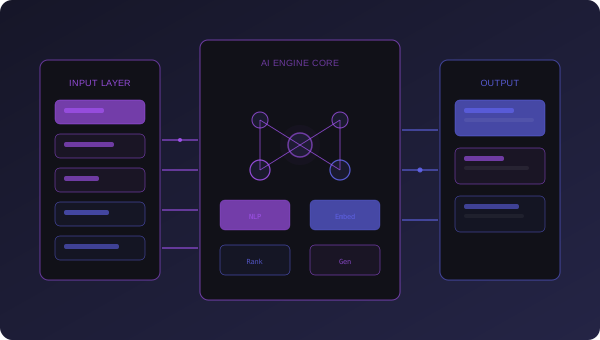
The Future of Content Personalization: From Rules to Autonomous Agents

Content personalization is evolving from static rule-based segments to AI agents that understand individual user context in real time. We explore where the industry is heading and how CuberIQ is leading the shift.
Beyond Static Rules
Content personalization began with simple rules: show banner A to visitors from North America and banner B to everyone else. As platforms matured, the rules became more sophisticated, incorporating user segments, behavior triggers, and demographic attributes. But rule-based personalization has a fundamental ceiling. Creating and maintaining rules requires human judgment at every decision point. A personalization engine with 50 rules is manageable; one with 5,000 rules serving a global audience across dozens of content types is a maintenance burden that few teams can sustain. The combinatorial explosion of user attributes, content variants, and context signals quickly outstrips what human rule-writers can effectively manage.
The industry is shifting from hand-crafted rules to learned models that infer personalization decisions from behavioral data. Instead of a marketer defining "show product comparison content to users who visited the pricing page," an AI-driven system observes that users exhibiting a cluster of behaviors, including pricing page visits, documentation searches, and competitor review reading, respond best to case study content that addresses migration concerns. The model discovers this pattern from data rather than requiring a human to hypothesize and encode it. This shift does not eliminate human judgment; it redirects it from writing individual rules to defining objectives, guardrails, and quality standards.
Real-Time Context and Behavioral Signals
Effective personalization requires understanding user context at the moment of content delivery, not just historical segments. A returning enterprise buyer researching a specific integration has different needs than the same person browsing casually on a weekend. Modern personalization systems ingest real-time signals including referral source, search query terms, session depth, scroll velocity, time-on-page patterns, and device context to build a dynamic understanding of user intent. CuberIQ's personalization engine processes these signals at the edge, making content adaptation decisions in under 10 milliseconds so that personalized content is delivered without additional latency compared to static delivery.
Audience segmentation itself is evolving. Traditional segments are static groups defined by marketers: enterprise vs. SMB, new visitor vs. returning customer. AI-driven segmentation discovers natural audience clusters from behavioral data and updates them continuously. A user might shift between implicit segments within a single session as their behavior signals evolve. CuberIQ supports both approaches: teams can define explicit segments for campaigns with known targeting requirements while allowing the AI to discover and serve emergent segments that human analysts might not have identified.
Privacy-First Personalization
The increasing effectiveness of personalization technology has intensified scrutiny around privacy. Regulations like GDPR and CCPA, combined with browser-level changes like the deprecation of third-party cookies and the rise of tracking prevention, are reshaping what personalization can and should look like. The next generation of personalization systems must deliver relevant experiences without relying on invasive tracking or cross-site identity graphs. CuberIQ's approach is privacy-first by design: personalization decisions are made using first-party behavioral signals within the current session and consented preference data, without fingerprinting, cross-site tracking, or third-party data enrichment.
CuberIQ is building toward a personalization model where AI agents act as autonomous content curators for each visitor. Rather than selecting from a fixed set of pre-built content variants, agents will compose personalized content experiences dynamically, assembling and adapting modular content blocks in real time based on the visitor's context and intent. This approach scales personalization beyond what variant-testing can achieve: instead of testing three headline options, the system generates the right headline for each visitor's context. We believe this shift from variant selection to dynamic composition will define the next era of content personalization, and we are investing in the infrastructure and models to make it practical at scale.
CuberIQ Team
CuberIQ Team