How We Built the AI Content Engine: Architecture and Lessons Learned
A deep dive into the technical architecture behind CuberIQ's AI Content Engine. We cover model selection, fine-tuning for brand voice, latency optimization, and the infrastructure that powers millions of AI-generated content pieces.
Architecture Overview
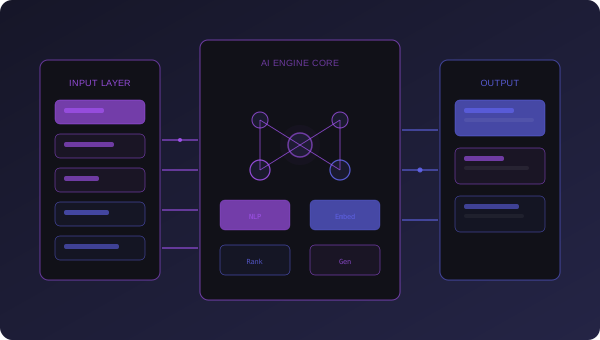
The CuberIQ AI Content Engine is a multi-stage pipeline that transforms high-level content briefs into publish-ready assets. At its core, the system is built on a microservices architecture where each stage of the content lifecycle is handled by an independent service communicating over an event-driven message bus. This design allows us to scale individual stages independently: the generation service, which is GPU-intensive, scales differently from the optimization service, which is primarily CPU-bound and I/O-heavy. The entire pipeline is orchestrated by a workflow engine that manages state, handles retries, and ensures exactly-once processing semantics even under partial failures.
The architecture separates concerns into four layers: ingestion, generation, optimization, and delivery. The ingestion layer normalizes inputs from various sources, including content briefs, structured data feeds, and existing content marked for refresh. The generation layer handles the computationally expensive work of producing draft content. The optimization layer applies brand voice alignment, SEO tuning, readability adjustments, and compliance checks. Finally, the delivery layer formats output for the target channel and hands off to the publishing pipeline.
Model Selection and Fine-Tuning
We evaluated foundation models across multiple dimensions: output quality, latency, cost per token, context window size, and instruction-following fidelity. Rather than committing to a single model provider, CuberIQ uses a routing layer that selects the optimal model for each task. Long-form article generation routes to models with large context windows and strong coherence over extended outputs. Short-form content like meta descriptions and social posts uses smaller, faster models where latency matters more than depth. This routing approach also provides resilience: if a provider experiences degradation, traffic shifts automatically to alternatives without impacting content delivery timelines.
Fine-tuning is where the Content Engine becomes unique to each customer. During onboarding, we ingest a corpus of existing published content and extract stylistic features: sentence structure patterns, vocabulary preferences, tone markers, and domain-specific terminology. This produces a brand voice embedding that is applied as a conditioning signal during generation. The result is content that sounds like your team wrote it, not like it came from a generic AI. Fine-tuning runs on a continuous feedback loop, incorporating editorial corrections to improve alignment over time.
The Content Pipeline
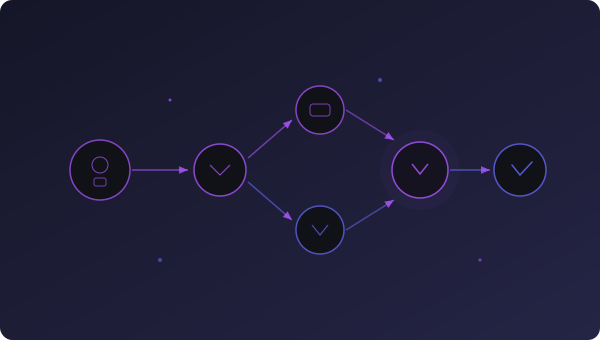
A content piece moves through four distinct phases. Generation produces the initial draft based on the brief, target keywords, and brand voice profile. Optimization applies a battery of post-processing steps: SEO keyword density analysis, readability scoring against the target audience level, internal link suggestion, and image alt-text generation. The Review phase presents the optimized draft alongside a quality scorecard covering factual confidence, brand alignment, and SEO projections. Finally, the Publish phase handles format conversion, metadata injection, and distribution to the configured channels. Each phase emits events that feed the analytics pipeline, giving teams visibility into throughput, quality trends, and bottleneck identification.
Performance was a non-negotiable design constraint. Content teams expect near-interactive response times for short-form generation and reasonable turnaround for long-form pieces. We achieve sub-second time-to-first-token for all generation tasks through a combination of model quantization, speculative decoding, and aggressive prompt caching. For long-form content, we stream output progressively to the editor interface so writers can begin reviewing and editing before generation completes. The system maintains a warm model pool sized based on historical demand patterns, with auto-scaling triggered by queue depth rather than CPU utilization to better match the bursty nature of content workloads.
Scaling AI Content Generation
Scaling AI content generation introduces challenges distinct from scaling traditional web applications. GPU resources are expensive and have longer provisioning times than CPU instances. Model inference exhibits variable latency depending on output length, which makes load balancing non-trivial. We address these challenges with a tiered compute strategy: latency-sensitive requests route to a pool of dedicated GPU instances with pre-loaded models, while batch workloads like bulk content refresh or translation are processed on spot instances during off-peak hours at significantly lower cost. The system processes over two million content operations per day across our customer base while maintaining p99 latency targets, and the architecture is designed to scale horizontally without requiring changes to the application layer.
CuberIQ Team
CuberIQ Team