Achieving Sub-50ms Response Times: Our Edge Delivery Architecture
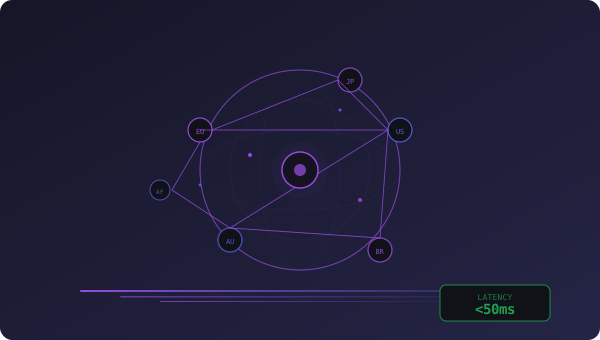
How CuberIQ delivers content in under 50 milliseconds to users worldwide. We break down our edge caching strategy, content invalidation pipeline, and the engineering decisions that make it possible.
Why Sub-50ms Matters
Every millisecond of content delivery latency has measurable impact on user engagement and conversion. Research consistently shows that pages loading in under 100ms feel instantaneous to users, while anything above 300ms introduces perceptible delay that degrades the experience. For content-heavy sites, the CMS API response time is the critical path: it determines how quickly the frontend framework can begin rendering meaningful content. Our target of sub-50ms API response times at the 95th percentile gives frontend teams a generous latency budget for client-side rendering, hydration, and interactive features without exceeding the 100ms threshold that users notice.
Achieving consistent sub-50ms delivery at global scale requires rethinking the traditional CMS architecture. Most headless CMS platforms serve content from a centralized origin, relying on CDN caching to mask the latency of cross-region requests. This works for static content but breaks down for personalized or frequently updated content where cache hit rates are low. CuberIQ takes a fundamentally different approach: instead of caching responses at the CDN edge, we replicate the content graph itself to edge locations, enabling true edge-native content resolution without origin round trips.
Edge Delivery Architecture
CuberIQ's edge delivery network operates across 80+ points of presence worldwide. Each edge node maintains a synchronized replica of the customer's content graph, stored in an embedded database optimized for read-heavy workloads. When a content API request arrives, the edge node resolves it locally, including reference resolution, field projection, and access control evaluation, without contacting the origin. This eliminates the latency variability introduced by origin round trips and CDN cache misses. The content graph is replicated using a conflict-free replicated data type (CRDT) protocol that guarantees eventual consistency with typical convergence times under 500 milliseconds after a publish event.
Cache invalidation is where most CDN-based architectures introduce unacceptable latency or stale content risks. CuberIQ sidesteps this problem entirely through its replication model. When content is published or updated, the change propagates through a dedicated low-latency messaging backbone to all edge nodes. Each node applies the update to its local replica atomically. There is no cache to invalidate because there is no cache: edge nodes serve directly from their local content graph. This means content updates are reflected globally within seconds of publishing, without the purge delays, race conditions, or thundering herd problems that plague traditional CDN invalidation strategies.
Auto-Scaling and Resilience
Traffic to content APIs is inherently unpredictable. A social media post going viral, a product launch, or a breaking news event can increase request volume by orders of magnitude within minutes. CuberIQ's edge nodes auto-scale horizontally based on request rate and CPU utilization, with new instances joining the mesh and receiving a content graph snapshot within seconds. The system is designed to degrade gracefully under extreme load: if an edge node becomes overwhelmed, requests are rerouted to the nearest healthy node with minimal additional latency. Each edge node operates independently, so a regional outage does not cascade to other regions.
Monitoring and observability are essential to maintaining performance targets in production. Every API request emits a structured trace that captures edge node selection, content resolution time, graph traversal depth, and response serialization overhead. These traces feed a real-time performance dashboard that surfaces p50, p95, and p99 latency by region, content type, and customer. Automated alerts trigger when latency percentiles drift above target thresholds, and the system can autonomously reroute traffic away from degraded edge nodes before users experience impact. Teams can access this performance data through the CuberIQ dashboard or export it to their existing observability stack via OpenTelemetry-compatible endpoints.
CuberIQ Team
CuberIQ Team