Introducing Agentic Workflows: Autonomous AI for Content Operations
Today we are launching agentic workflows in CuberIQ, bringing autonomous AI agents to content management. Learn how goal-oriented agents can handle everything from content QA to predictive publishing.
What Are Agentic Workflows?
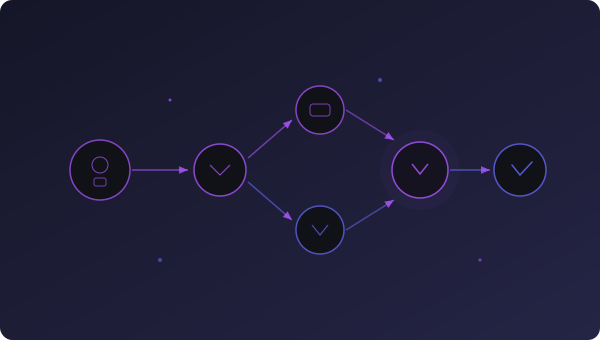
Traditional content management automation relies on rigid, rule-based triggers: publish at 9 AM, send a notification when a draft is approved, resize an image on upload. These workflows are deterministic and brittle. Agentic workflows represent a fundamental shift. Instead of following predefined steps, AI agents receive high-level goals and autonomously determine the best sequence of actions to achieve them. An agentic workflow might receive the goal "optimize this week's publishing schedule for maximum engagement" and independently analyze historical performance data, audience timezone distributions, competitor publishing patterns, and content topic affinity before producing a revised calendar with rationale for each decision.
The distinction between traditional automation and agentic workflows comes down to planning and adaptation. A rule-based system executes the same steps regardless of context. An agent observes, reasons, plans, acts, and then evaluates the outcome to refine its approach. This loop, often called the observe-orient-decide-act (OODA) cycle, allows agents to handle ambiguous situations that would break a conventional automation pipeline. When an agent encounters an unexpected content format or an API returning partial data, it can adjust its strategy rather than failing silently or throwing an error.
The Agent Suite in CuberIQ
CuberIQ ships with six purpose-built agents, each designed for a specific domain within content operations. The Content Scheduler agent analyzes engagement patterns across channels and recommends optimal publish times, factoring in audience behavior, content type, and seasonal trends. The SEO Optimizer agent continuously monitors search performance, identifies keyword gaps, and suggests content updates to maintain or improve rankings. The QA Agent performs automated content audits, checking for broken links, accessibility issues, readability scores, brand guideline compliance, and factual consistency across your content graph.
On the distribution side, the Analytics Agent aggregates performance data across GA4, Search Console, and social platforms to surface actionable insights without requiring your team to context-switch between dashboards. The Publishing Agent handles multi-channel distribution, adapting content format and metadata for each target platform while maintaining version consistency. Finally, the Localization Agent manages translation workflows, coordinates with external translation services or AI translation models, and ensures localized content stays synchronized with source material as it evolves.
Autonomy Levels and Human Oversight
Not every team is ready to hand full control to an AI agent, and not every task warrants it. CuberIQ implements a three-tier autonomy model. At the Advisory level, agents analyze data and make recommendations but take no action without explicit human approval. The Supervised level allows agents to execute routine tasks autonomously while flagging edge cases for review. At the Autonomous level, agents operate independently within defined guardrails, escalating only when they encounter situations outside their confidence threshold. Teams can configure autonomy levels per agent and per content type, giving editorial teams full control over the trust boundary.
Getting started with agentic workflows requires no infrastructure changes. Agents are activated from the CuberIQ dashboard and begin by operating in Advisory mode, learning your content patterns and team preferences. Over a two-week onboarding period, each agent builds a baseline understanding of your content operations, after which you can progressively increase autonomy levels. Every agent action is logged with full traceability, including the reasoning chain that led to each decision, so your team always understands not just what an agent did but why it chose that approach.
CuberIQ Team
CuberIQ Team